Start with the OEM socket.
Agree voltage, signal quality, interfaces, package, environmental conditions and qualification evidence. A reusable digital block cannot erase those physical constraints.

DeepGrid’s mature-node strategy connects motion, power, sensing, interfaces and safety to the needs of equipment makers. DG32 is the detailed pre-silicon engineering case; the wider portfolio remains a set of individually scoped architectures.
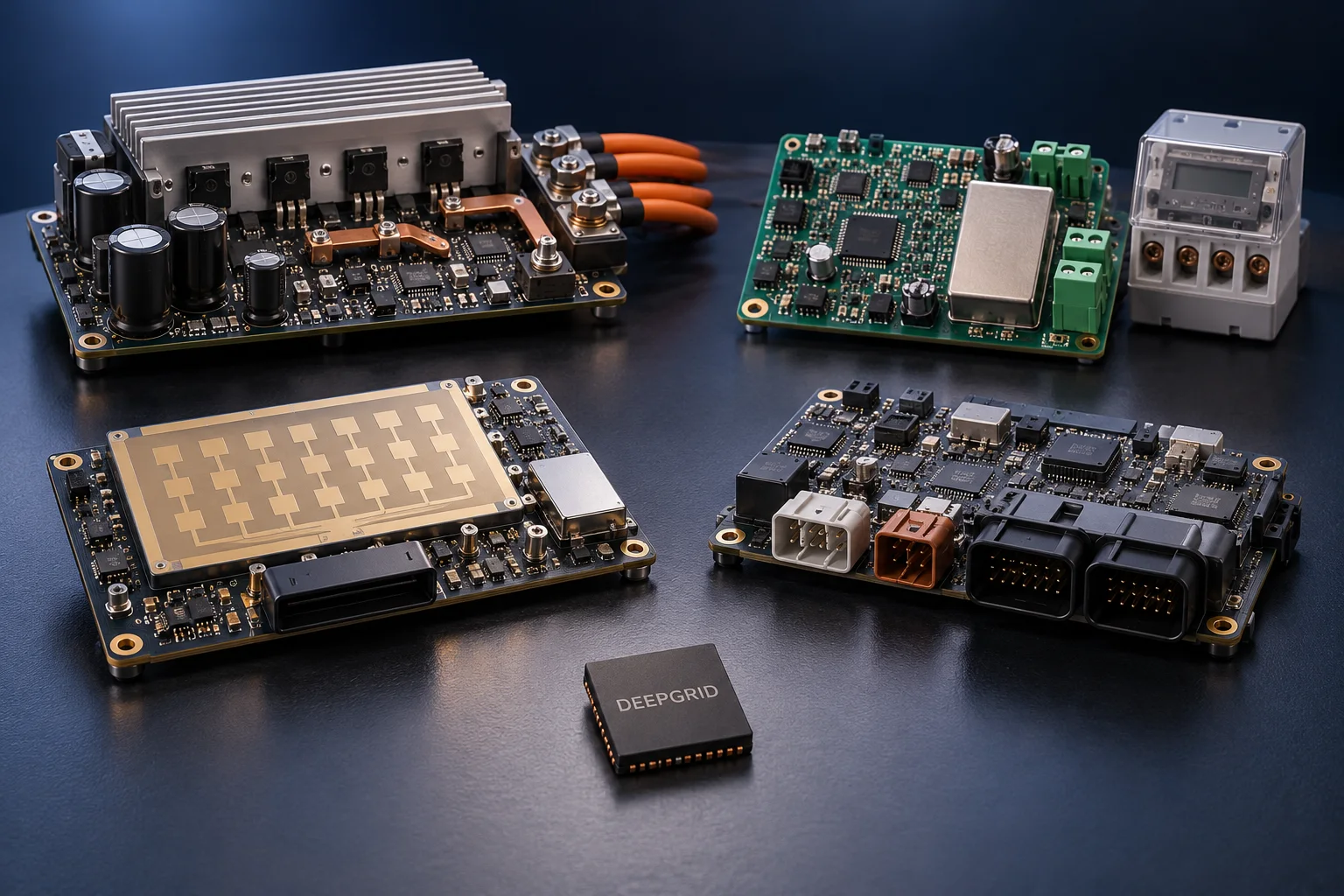
Reuse implementation methods and digital building blocks across the portfolio.
Combine suitable dies and processes in a package. This is a portfolio concept; DG32 uses its own QFN-64 package.
A shared processor, tools and verification flow make the second chip cheaper than the first. Voltage, noise, radio frequency and screening do not transfer: each socket sets its own physics, and those blocks are engineered for it.
A common RISC-V foundation and reusable digital IP can serve multiple product architectures.
Reuse does not make every chip the same implementation, frequency or safety configuration.
Mature-Node Silicon System Architecture · §5: Canonical Processor ArchitectureIn-house engineering, open-source tools and shared MPW fabrication are the development method.
A reusable flow is not an achieved cost multiplier or a guaranteed turnaround.
Mature-Node Silicon System Architecture · §§2–3References, converters, high-voltage devices and protection structures must meet the socket’s physical requirements.
Analog and high-voltage work can require additional silicon cycles.
Mature-Node Silicon System Architecture · §3: Two-Speed Development RealityRadar RF uses a SiGe front end; harness interfaces require their own fault and ESD protection.
Digital IP portability does not establish analog or RF portability.
SKU Architecture Compendium · §2, Sheets 6 and 8; §3.3The SiP concept uses a four-layer organic BT-resin, 15 × 15 mm BGA package; a later compute die would join by flip-chip.
A proposed multi-die architecture, distinct from DG32’s 9 × 9 mm QFN-64. Package qualification remains separate.
SKU Architecture Compendium · §3.5: Sheet 13DG SDV is the architecture the portfolio is drawn from: secure, safe, host and accelerator domains on one regulated interconnect. Each product takes the part of it its socket needs.
The products are scaled-down instances of this reference: SKU-4 carries a two-core version of the safe domain, SKU-9 adds the secure domain at the vehicle zone, and D100 brings the host and accelerators onto a drone. The platform itself is an architecture, not a product, and its safety and security levels are design targets.
DG SDV architectureThe whitepaper’s “boxes, not chips” strategy works through equipment makers and their assemblies or LRUs. It is a proposed commercial route, not proof of contracted demand, legal procurement eligibility or qualified production.
Agree voltage, signal quality, interfaces, package, environmental conditions and qualification evidence. A reusable digital block cannot erase those physical constraints.
Architecture breadth, forecasts and a possible procurement route are not customer orders. Evaluation needs named requirements and decision gates.
The 198-day model allocates 30 digital and 168 physical days. It is analytic planning; analogue and high-voltage programmes may need extra silicon cycles.
Architecture, requirements and review records
RTL verification and physical implementation reports
Fabrication records and returned silicon
Board measurements and functional test results
Electrical limits across conditions
Reliability, safety and application evidence
Analog, power and RF requirements continue to govern their own blocks.
Distinct process and qualification plans, not interchangeable qualified fabs.
Pause Chip 2 for one cycle and reallocate its capital to Chips 1 and 3.
Defer all forward defence revenue projections by 12 months, updating materials within 30 days.
Exit ceiling-fan drivers and focus on two-wheelers and proprietary modules.
Disclose the delay and use the SkyWater and IHP routes for production plans.
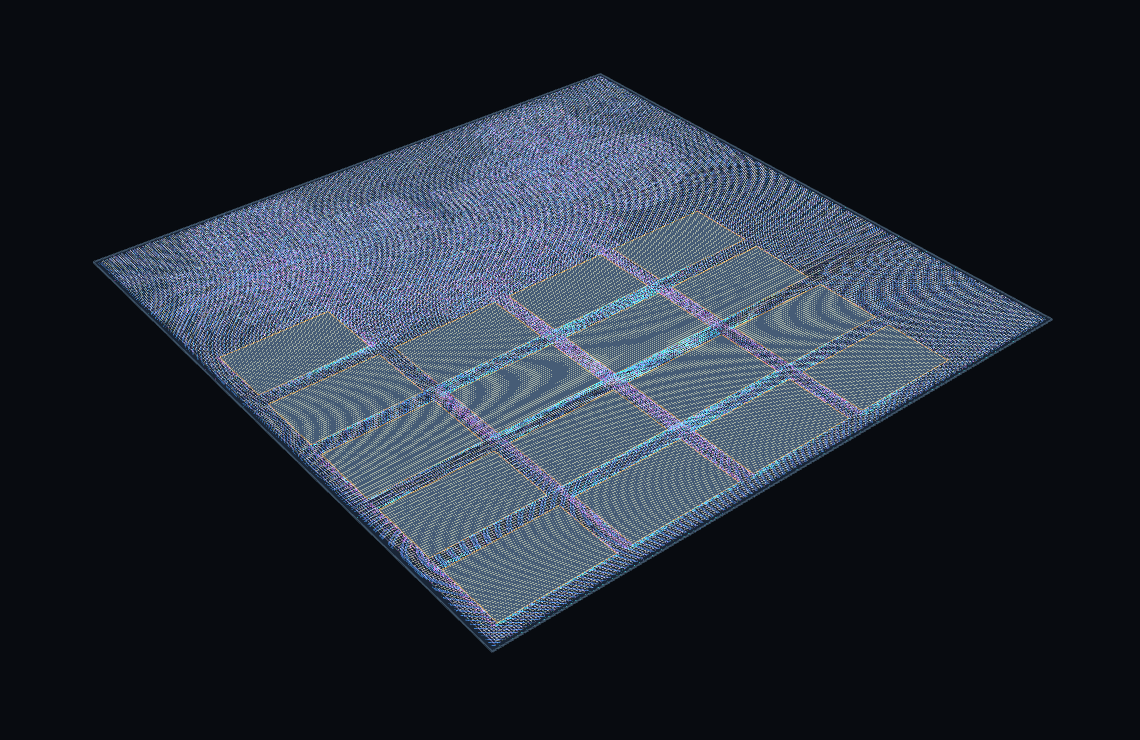
The DeepGrid Silicon Engine capture shows the DG32-LITE layout. It records pre-silicon design work; manufactured-silicon measurements and product qualification are separate milestones.
Inspect the complete layout image