
Three chips for the vehicle zone: the SKU-9 gateway, the SKU-7 radar and DG32-LITE.
DeepGrid’s proposed parts serve sensing, displays, power and communications around the vehicle. Their value depends on how they fit the vehicle architecture and safety responsibilities.
- Zonal gatewayThe zonal layer of a software-defined vehicle: gateway, smart inputs and outputs, and the safety and security edge.
- DG32-LITE safety microcontrollerEV battery management, and braking and steering controllers. Braking and steering need CAN-FD, which is on the DG32 roadmap and not on DG32-LITE.
- 77 GHz 4D radarDeepGrid’s own truck mirror-tower radar, and automotive emergency braking.
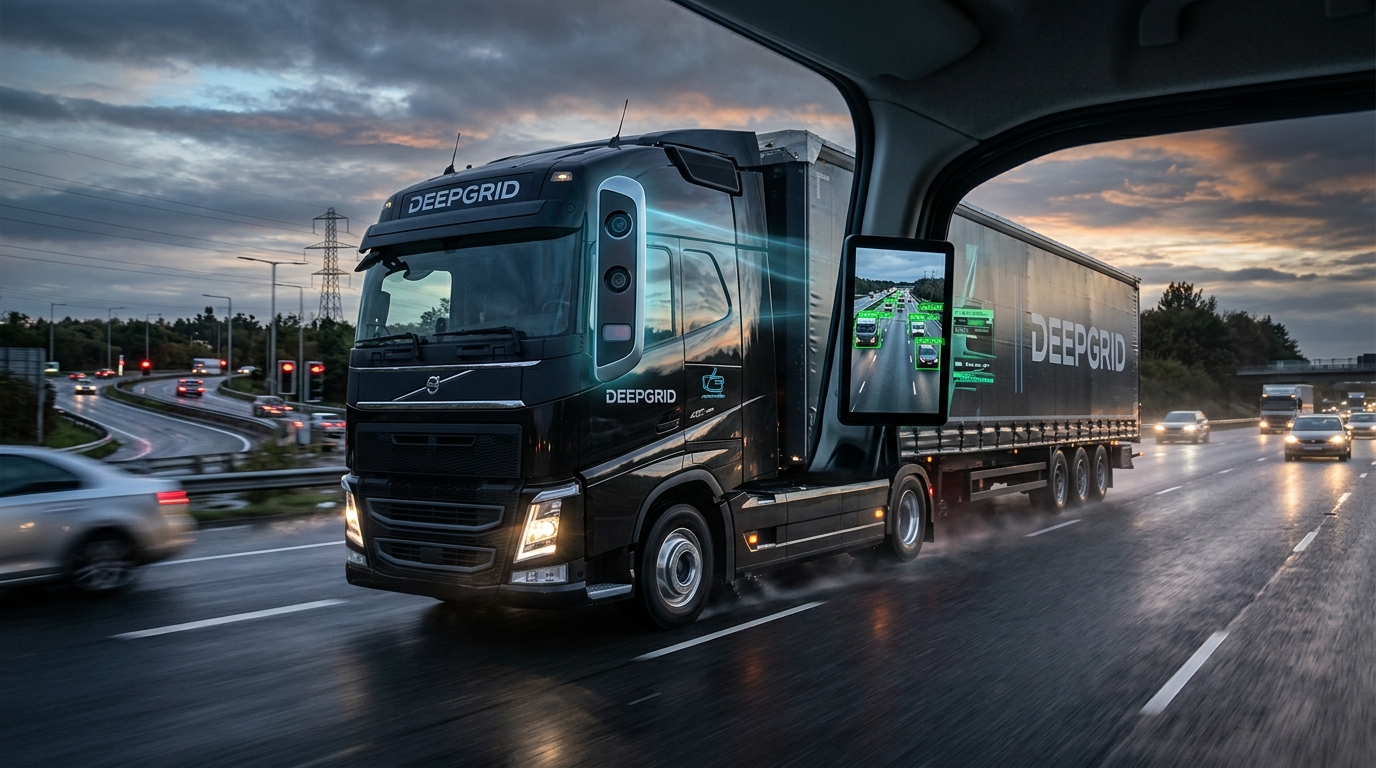
Concept render of a truck on a wet highway at dusk
Mature nodes own the edges of the vehicle; the central computer is not claimed.
A software-defined vehicle splits into a central computer and zones. The zones are where wiring, switching, protection and the safety-critical edges live.
Each zone gathers sensors and loads near where they are, so the harness gets shorter. The zonal controller routes messages on time, protects every load circuit, and keeps safety functions isolated from comfort functions.
- Sense: SKU-7Radar returns range and velocity of up to 64 targets
- Link: SKU-5CAN-FD and RS-485 carry the data off the sensor, failsafe when the bus is open
- Route: SKU-9Time-sensitive switching delivers brake messages with bounded latency
- Protect: SKU-9Sixteen smart fuses switch loads and trip on an I²t model
- Supervise: SKU-4Battery management and actuator controllers check their own computation
Five chips, each with one job here.
What each part does in this system, and where it stands today.
Zonal gateway
The zonal layer of a software-defined vehicle: gateway, smart inputs and outputs, and the safety and security edge. Replaces: Imported zonal controllers and CAN, LIN and FlexRay to Ethernet gateways.
Open the SKU-9 pageDG32-LITE safety microcontroller
EV battery management, and braking and steering controllers. Braking and steering need CAN-FD, which is on the DG32 roadmap and not on DG32-LITE. Replaces: Functional-safety microcontrollers of the Microchip and Renesas class.
Open the SKU-4 page77 GHz 4D radar
DeepGrid’s own truck mirror-tower radar, and automotive emergency braking. Replaces: Imported 77 GHz radar front ends and the processing chips that go with them.
Open the SKU-7 pageRS-485 and CAN-FD transceiver
The CAN-FD and RS-485 link at every node on the vehicle bus. Replaces: CAN and RS-485 interface chips from TI, ADI and Renesas, many of which defence platforms can no longer buy.
Open the SKU-5 pageSOH-aware battery-management controller
The battery-management controller for e-2W and e-3W packs, with on-chip state-of-health inference and hardwired protection. Replaces: The MCU beside a TI BQ769xx or ADI ADBMS front end, the separate neural accelerator for state-of-health inference, and the authentication chip: three parts become one.
Open the SKU-11 pageFour ways this system fails, and the block that catches each.
The failure modes this system has to survive, and the part of the design that answers each one.
A short in the harness
A pyro-fuse is slow and one-shot. A smart electronic fuse cuts off in microseconds and can be reset, if it survives the harness inductance.
A late brake message
Bulk data on the same Ethernet link can delay a critical frame. A time-aware shaper reserves the slot so it arrives within a bound.
A miswired or dead bus
An open or shorted bus must read as a known state. Failsafe biasing and thick-oxide outputs let the transceiver survive and report it.
Comfort reaching control
A lighting command must never touch steering registers. Memory protection and bus firewalls enforce that inside the zonal controller.
Evidence today: all five are at design stage.
- SKU-9, Zonal gateway: Architecture diagram and status in the SKU Blueprint.
- SKU-4, DG32-LITE safety microcontroller: Simulation and implementation records; no measured silicon result published.
- SKU-7, 77 GHz 4D radar: Architecture diagram and status in the SKU Blueprint. The SiGe front end has no FPGA equivalent, so it is proven on silicon or not at all.
- SKU-5, RS-485 and CAN-FD transceiver: Architecture diagram and status in the SKU Blueprint.
- SKU-11, SOH-aware battery-management controller: Block specification: twenty blocks in six groups, reusing the feature-complete DG32-Max platform RTL.
Send the system and its numbers; the reply maps them to each part.
The zone, its loads and buses, the latency the messages need and the safety target are what we need to answer.