
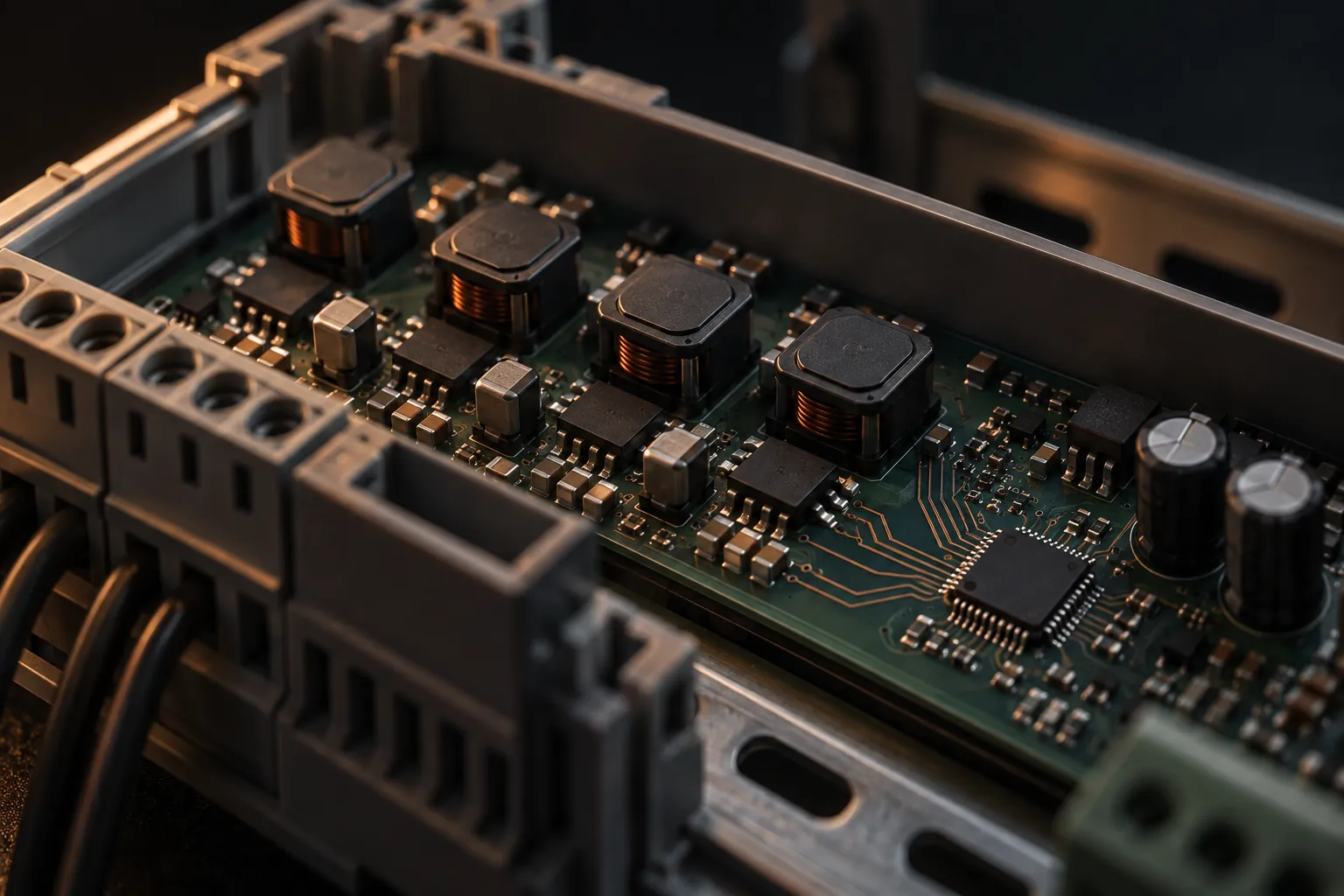
Three board parts below the firmware: a four-rail supervisor, a secure MCU and a bus transceiver.
Power supervision and interfaces are small parts of a board with system-wide consequences. Select them against actual supply disturbances, wiring and service conditions.
- Voltage supervisorWatches up to four power rails and latches a fault, on nearly every circuit board.
- DG32-Max secure microcontrollerA secure microcontroller that boots only signed firmware, for industrial controllers, drone flight controllers, EV chargers and IoT gateways.
- RS-485 and CAN-FD transceiverShips with every node on every industrial bus, including harsh wiring harnesses.
Concept render of an industrial controller board with a small supervisor chip
Supervision and the bus link decide whether a board starts and talks predictably, below firmware.
Almost every electronic board needs the same three things below its processor: clean supplies that start in the right order, something that holds the processor in reset until those supplies are good, and a robust link to the rest of the system.
These parts are small and unglamorous, and they decide whether a board starts predictably and survives a miswired cable. They are also the parts most exposed to obsolescence when a supplier discontinues them.
- PowerRails come up from the input supply in sequence
- Supervise: SKU-6Four rails checked against thresholds, with an 8 µs deglitch
- ReleaseRESET_N releases the processor 200 ms after the rails are good
- Link: SKU-5RS-485 or CAN-FD to the rest of the system, ESD-protected
- Display: SKU-8Panel drive where the board has a local display
Four chips, each with one job here.
What each part does in this system, and where it stands today.
Voltage supervisor
Watches up to four power rails and latches a fault, on nearly every circuit board. Replaces: Supervisor chips from TI and Maxim, which sit on almost every circuit board.
Open the SKU-6 pageDG32-Max secure microcontroller
A secure microcontroller that boots only signed firmware, for industrial controllers, drone flight controllers, EV chargers and IoT gateways. Replaces: MAX32655-class imported secure MCUs, and the separate secure element a board adds to boot only signed firmware: one die replaces the pair.
Open the SKU-10 pageRS-485 and CAN-FD transceiver
Ships with every node on every industrial bus, including harsh wiring harnesses. Replaces: CAN and RS-485 interface chips from TI, ADI and Renesas, many of which defence platforms can no longer buy.
Open the SKU-5 pageRugged display driver
Industrial control panels, rail passenger displays and automotive instrument clusters. Replaces: Imported timing-controller and column-driver chipsets in rugged and industrial displays.
Open the SKU-8 pageFour ways this system fails, and the block that catches each.
The failure modes this system has to survive, and the part of the design that answers each one.
A brownout that corrupts memory
A supply dips below threshold. The supervisor latches the fault and resets the processor before it writes garbage.
Converter noise mistaken for a fault
A buck converter’s ripple crosses the threshold for nanoseconds. The 8 µs deglitch ignores it; a real dip lasts longer.
Firmware that has stopped
A windowed watchdog expects a kick neither too early nor too late, and resets the board when it gets neither.
An electrostatic hit on a connector
Bus pins leave the enclosure. The transceiver’s ESD structures take the discharge instead of the logic behind them.
Evidence today: one chip is FPGA-validated, three are at design stage.
- SKU-6, Voltage supervisor: FPGA-validated: the supervisor sensing chain runs as circuit code on the same Artix-7.
- SKU-10, DG32-Max secure microcontroller: RTL feature-complete; every bench and firmware test passes, including secure boot on all three test images. No silicon result yet.
- SKU-5, RS-485 and CAN-FD transceiver: Architecture diagram and status in the SKU Blueprint.
- SKU-8, Rugged display driver: Architecture diagram and status in the SKU Blueprint.
Send the system and its numbers; the reply maps them to each part.
The rails to supervise, the bus and its wiring, and the reset behaviour your board needs are what we need to answer.