
Deepgrid Semi
DG32 · LOCKSTEP RISC-V MOTOR-CONTROL SILICONPRE-SILICON · ENGINEERING EVIDENCE
Request a discussion

Eleven mature-node chips and one drone SoC, from a 120 V motor controller to a 77 GHz radar.

Eleven mature-node products and the separate D100 programme address different equipment needs. Compare the function, what it could replace and what remains to be proven before adoption.

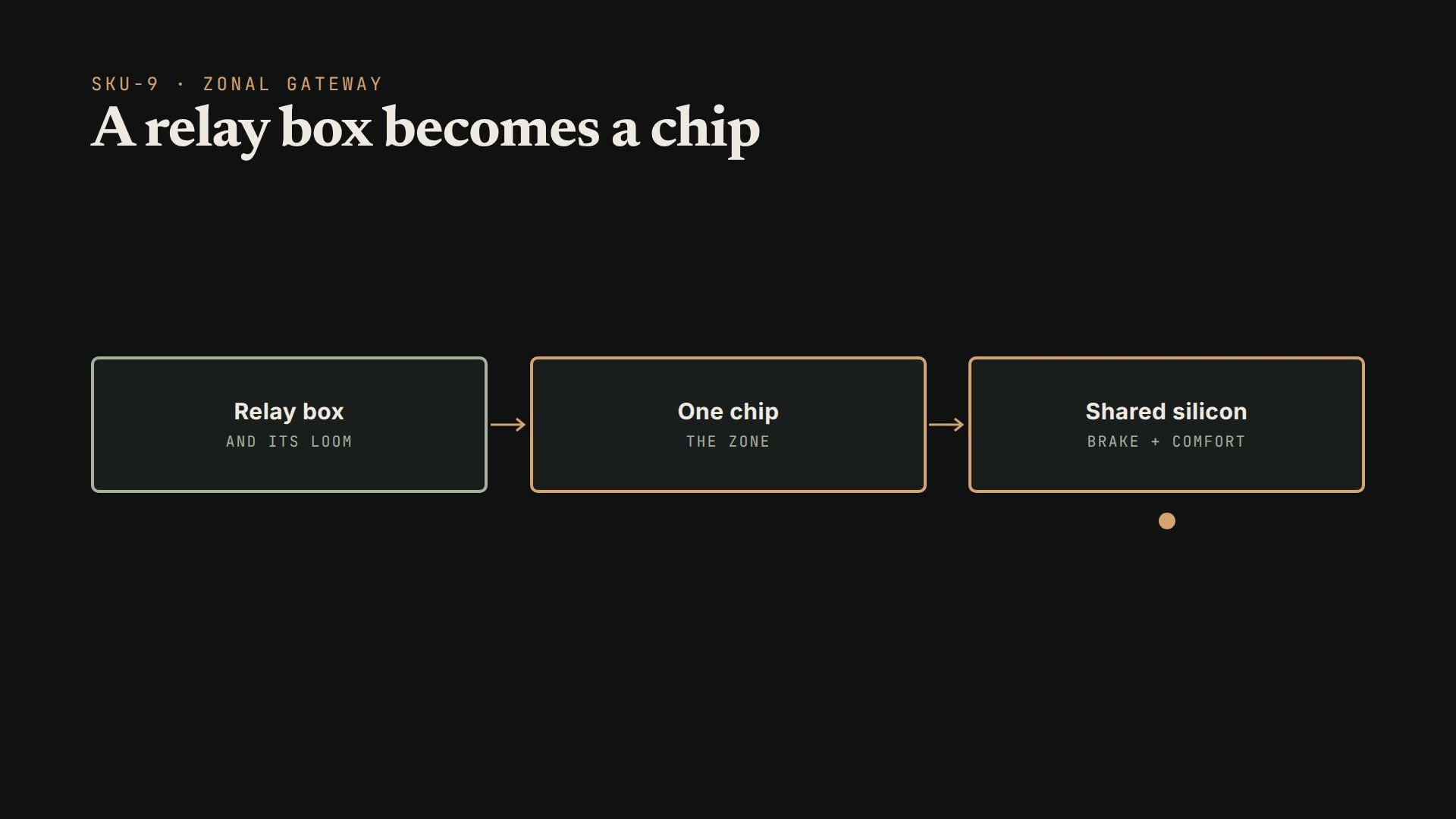
Twelve parts, each built for one physical job.

Pre-silicon: every figure on a tile is a design target. Open a tile for its three deciding figures and its film.

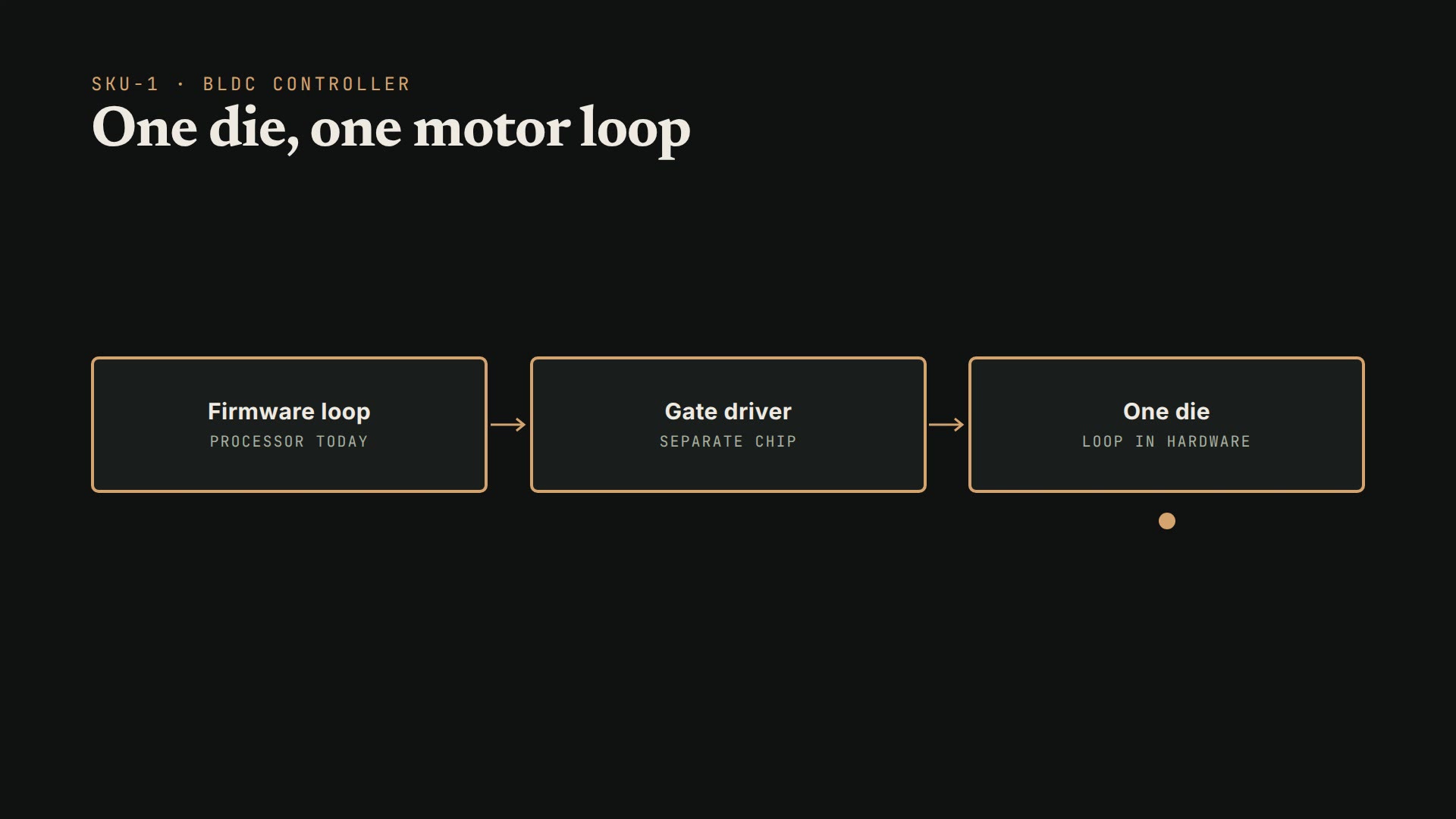
  • SKU-1 · 130 nm BCD

    BLDC motor controller

    One chip runs the motor and controls its supply up to 120 V.

    Top of the motor supply it controls
    120 V
    Hardware PID loop
    < 1 µs
    PWM, seven channels
    200 kHz
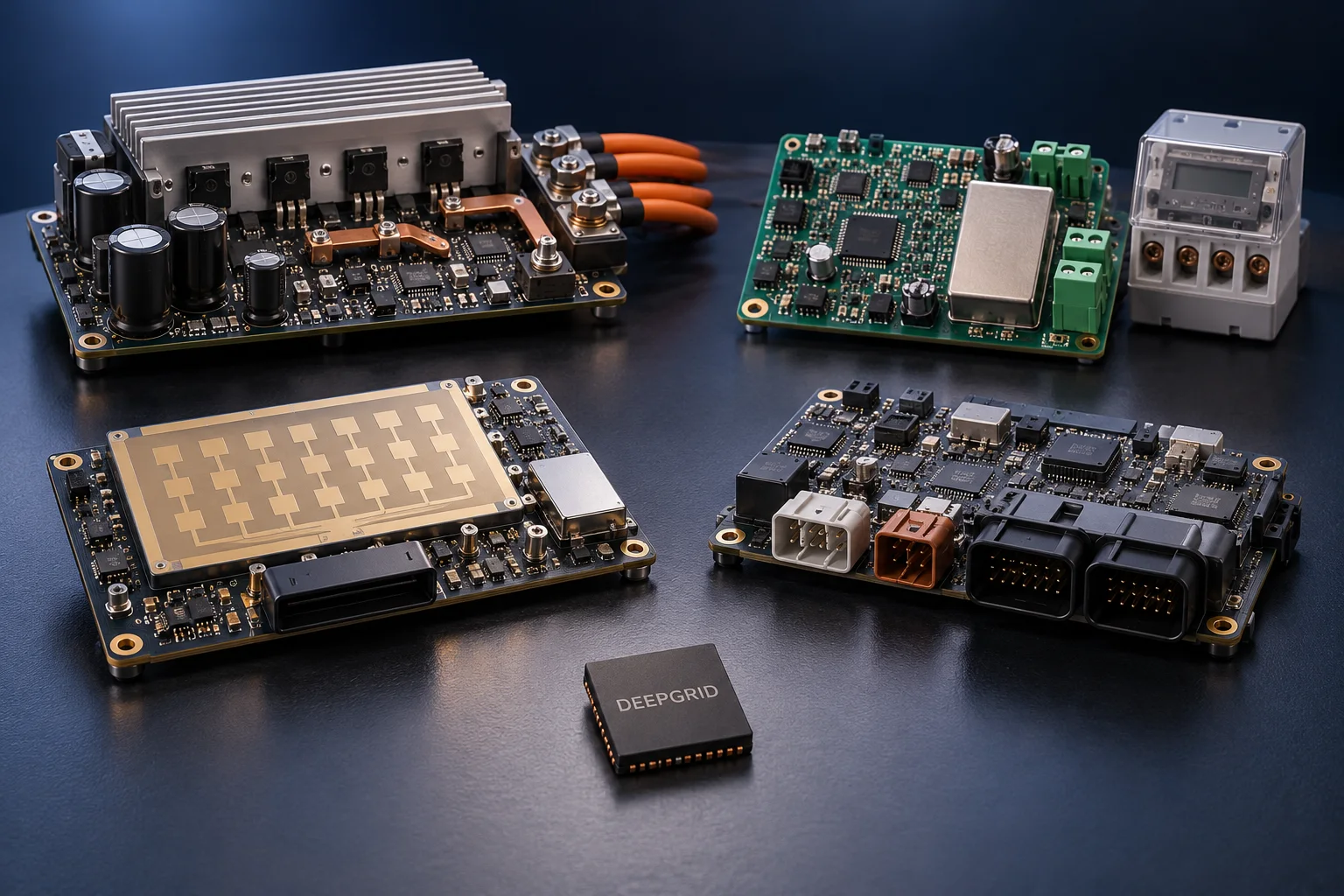
DeepGrid portfolio concept with separate motor-drive, metering, radar and zonal-interface assemblies
Motion, metering, sensing and zonal interfaces. New DeepGrid portfolio concept · concept illustration, not a product photograph or deployment evidence. DeepGrid silicon remains pre-silicon.
SKU-1 Motor control original DeepGrid architecture diagram
SKU-1 · The control engine and the power stage, in one architecture.
Original DeepGrid architecture diagram · pre-silicon design. Explore this part
Drag to rotate. Conceptual model, not a mask layout.

DG32-LITE and DG32-2DOM share one pinout, pin for pin

DG32-LITE: two RISC-V cores in hardware lockstep, the motor-drive peripherals and the FOC maths, at 50 MHz.

In lockstep: CHECKER runs two cycles behind MAIN2 cores
Fixed hardware cost of one FOC loop~300 cycles
One signal pinout for both chips44 pins

Self-test cannot see a fault between runs;
lockstep checks every store.

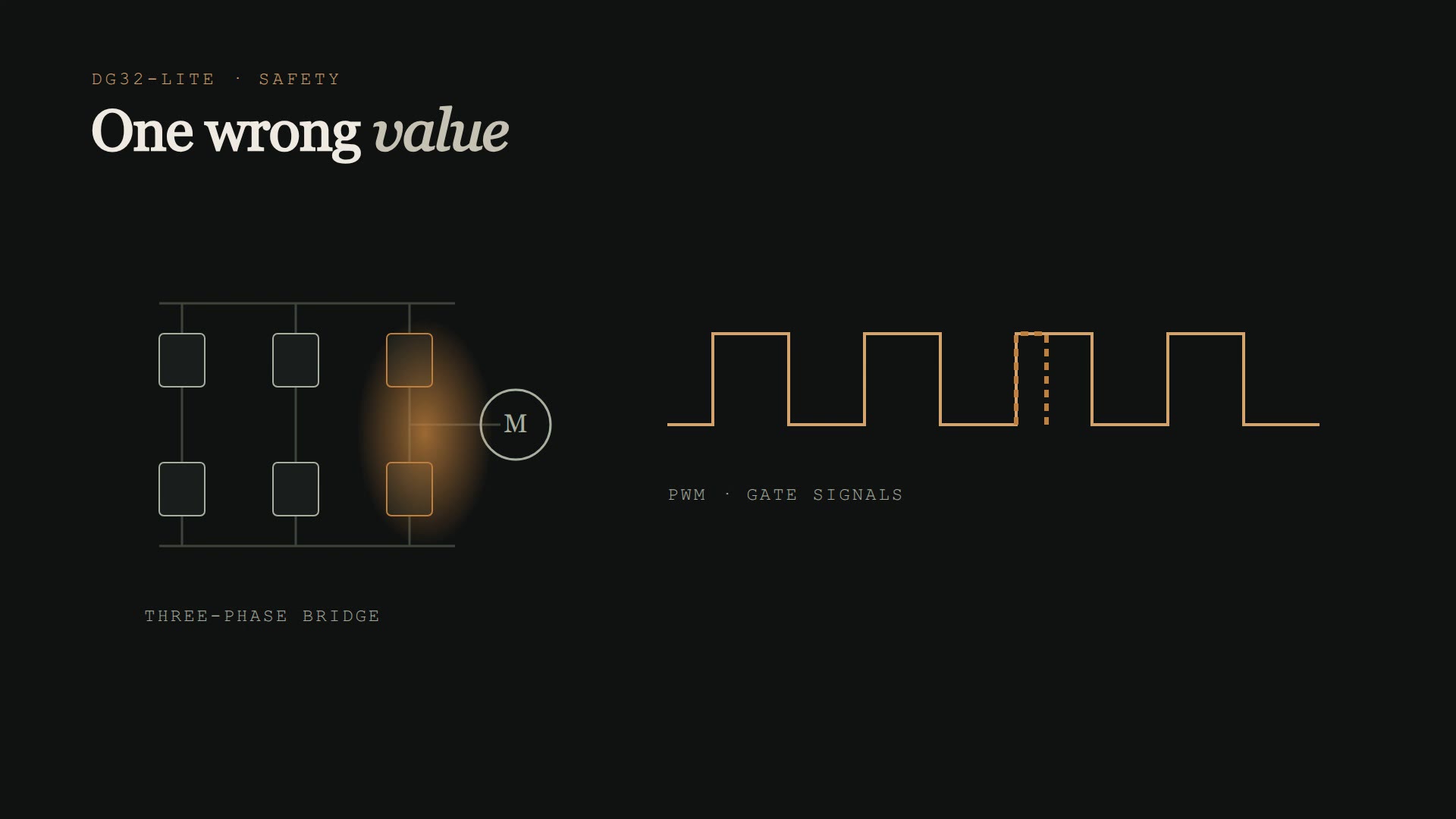
Motor control drives power electronics, and a silent CPU fault can destroy a bridge. Hardware lockstep has lived in automotive MCUs such as Infineon AURIX, NXP S32K and TI Hercules; DG32-LITE brings it to the entry-level motor-control tier.

Software self-test compared with hardware lockstep
QuestionSoftware self-testDG32 hardware lockstep
When it checksPeriodically, when the test is scheduledOn every committed store
Between checksBlind: a fault can act before the next runNo gap: CHECKER runs two cycles behind
Who stops the bridgeFirmware, once it noticesFAULT_N, in hardware, without waiting for firmware

The 39-cycle figure is measured in simulation, from an injected fault to the latch.

Six block groups on one clock;
DG32-2DOM adds a seventh on its own.

Choose a block to see what it does and why it is there. Then switch to DG32-2DOM: the six groups are the same design from the same source, and only the attention engine and its bridges are new.

50 MHz control domain

SAFE

Safety core

  • MAIN and CHECKER cores run identical inputs; CHECKER trails by two cycles
  • Every committed store is compared; a mismatch latches the first cause and drives FAULT
  • Fault injection lets firmware prove the path works on real silicon
  • Windowed watchdog faults on a kick that is too early or too late
  • Supply-good monitoring with deglitching and reset sequencing

WhyMotor control drives power electronics. A silent CPU fault can destroy a bridge; a second core that must agree bit-for-bit turns that fault into an observable signal.

Open the full DG32-LITE diagram
Full specifications, side by side
DG32-LITE and DG32-2DOM compared
AreaDG32-LITEDG32-2DOM
Control coreTwo RV32IM cores in hardware lockstepIdentical, frozen and unchanged
Boot and memory64 KB boot ROM, 32 KB dual-port SRAM, external QSPI flashIdentical
Motor and sensingPWM with brake, 4 × DShot, encoder and Hall, SAR ADC, CORDICIdentical
Connectivity2 × UART, SPI, I²C, GPIO, JTAG and scanIdentical
Control-loop budget~300 hardware cycles per loop; ~100 kHz simulated ceilingIdentical; the engine cannot extend it
ClocksOne 50 MHz domain50 MHz control domain plus a 114 MHz compute domain
On-chip computeNoneINT8 attention engine, bit-exact to the software model
Package and pinoutQFN-64, 9 × 9 mm, 44 signal pinsIdentical; the engine adds no pads
Supplies1.8 V core, 3.3 V I/OIdentical
Power estimate~0.43 W at 50 MHz (tool estimate)Same figure stated; no separate engine figure yet
Die2.9 × 4.5 mm core blockIts own 3.4 × 4.5 mm die
StatusPre-silicon; dated shuttle plan in sourceDesign complete, in physical trials

DG32-LITE

First silicon · September 2026 multi-project shuttle

CPU
2 × RV32IM, 32-bit, in hardware lockstep
Clock
One 50 MHz domain; core measured at ~55–62 MHz post-route
Memory
64 KB boot ROM · 32 KB SRAM · external QSPI flash
Motor
3-phase PWM with dead-time and hardware brake · 4 × DShot
Sensing
Encoder A/B/Z + 3 Hall · 8-bit differential SAR ADC, ~200 kSa/s
Math
Hardware CORDIC: sin, cos, atan2, magnitude
Interfaces
2 × UART · SPI to 25 MHz · I²C 100/400 kHz · QSPI · GPIO · JTAG
Package
QFN-64, 9 × 9 mm, 0.5 mm pitch, exposed ground paddle
Supplies
1.8 V core · 3.3 V I/O
Power
~0.43 W at 50 MHz (tool estimate, not measured)
Process
130 nm CMOS

DG32-2DOM

Design complete · in physical trials

CPU
Same lockstep pair as DG32-LITE
Clocks
50 MHz control domain · 114 MHz accelerator domain
Accelerator
INT8 attention: QKᵀ, softmax, weighted sum, requantise, in one kick per band of query rows
Accuracy
Bit-exact to the golden software model
Keys
Up to 400 per head
Isolation
Crosses to the CPU through clock-domain bridges; never stalls the control core
Timing
Closed with positive slack at both 50 MHz and 114 MHz
Pinout
Identical to DG32-LITE: the engine adds no pads

Pre-silicon. Figures are design values verified in simulation and static timing, not measurements on fabricated parts, unless marked otherwise. The ~0.43 W power figure is a vectorless tool estimate at 25 °C and 1.8 V.

The loop runs in hardware,
so its cost is fixed.

Sampling, the Park transforms and the PWM update are dedicated blocks costing about 300 cycles at any loop rate; the CPU keeps only the two PI regulators. What is left at each rate is the firmware budget.

  • 10 kHz5,000 cycles · ~300 hardware · ~4,700 CPUFull FOC current and speed loop with an observer
  • 20 kHz2,500 cycles · ~300 hardware · ~2,200 CPUFOC with field-weakening and a state observer
  • 50 kHz1,000 cycles · ~300 hardware · ~700 CPUInner current loop only; regulators must be tight
  • 100 kHz500 cycles · ~300 hardware · ~200 CPUThe simulated ceiling: ~5 µs acquisition plus ~5 µs compute

Cycle costs measured in simulation at the 50 MHz clock; 100 kHz is the simulated ceiling, not a bench result.

Mature-node silicon,
around the sub-10 nm core.

Sub-10 nm silicon cannot withstand 28 V to 120 V transient rails, carries no 24-bit high-dynamic-range analog front end, and does not survive automotive and military screening from −55 °C to +125 °C without external support. DeepGrid anchors those physical interfaces on 130 nm and 180 nm, taking the satellite sockets around the sub-10 nm central compute rather than competing with it. DG32 is SKU-4 of that portfolio, the lockstep safety MCU.

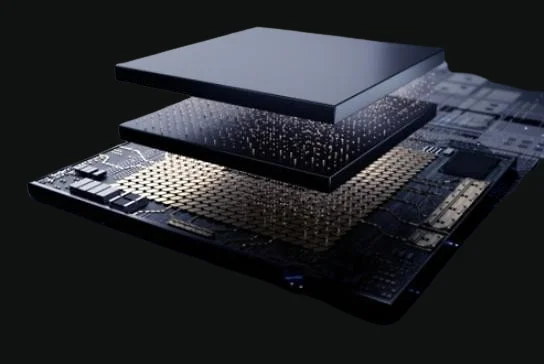
Exploded view of a layered chip package: die, substrate and lid separated
DeepGrid’s multi-die package concept, from deepgridsemi.com. The D100 at the foot of this table is the portfolio’s multi-die part.
Compare process nodes across the portfolio
The twelve-chip portfolio and where DG32 sits in it. Each part opens its card on the applications page, with where it goes, what it replaces and what it rests on.
SKUPartNode
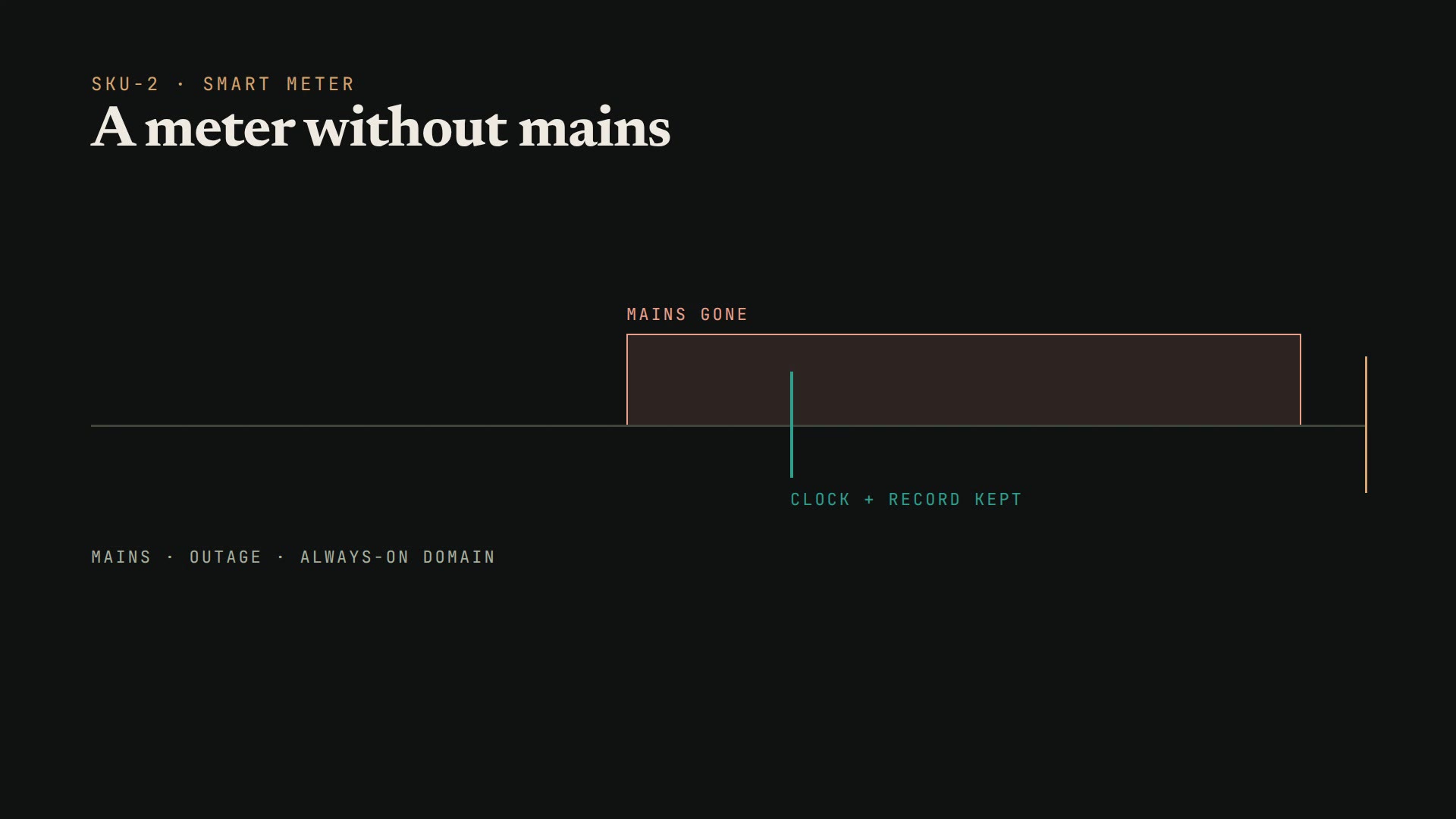
SKU-1BLDC Motor Controller130 nm BCD
SKU-2Smart-Meter SoC130 nm CMOS
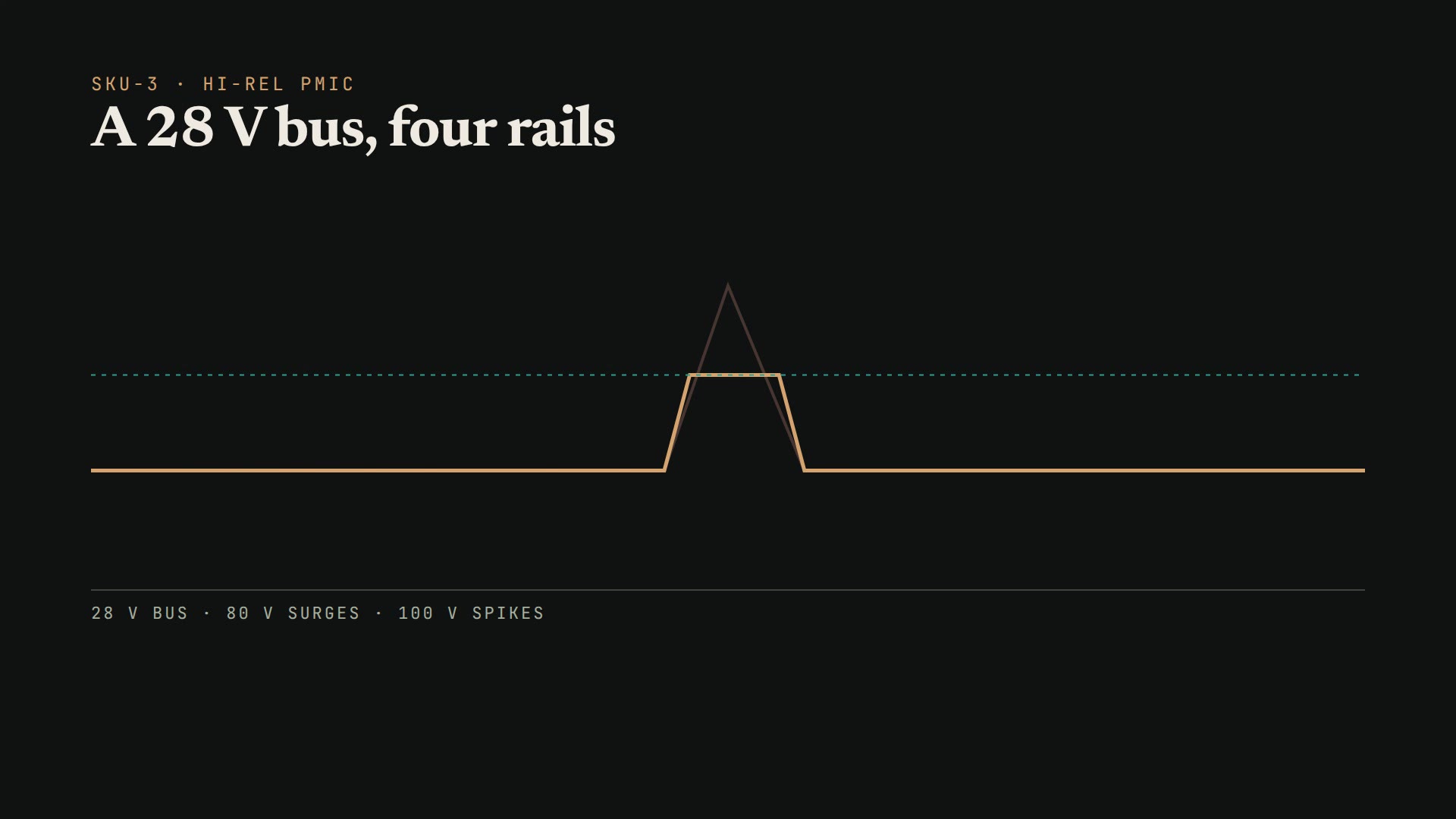
SKU-3High-Reliability PMIC180 nm BCD
SKU-4DG32-LITE130 nm CMOS
SKU-4 variantDG32-2DOM130 nm CMOS
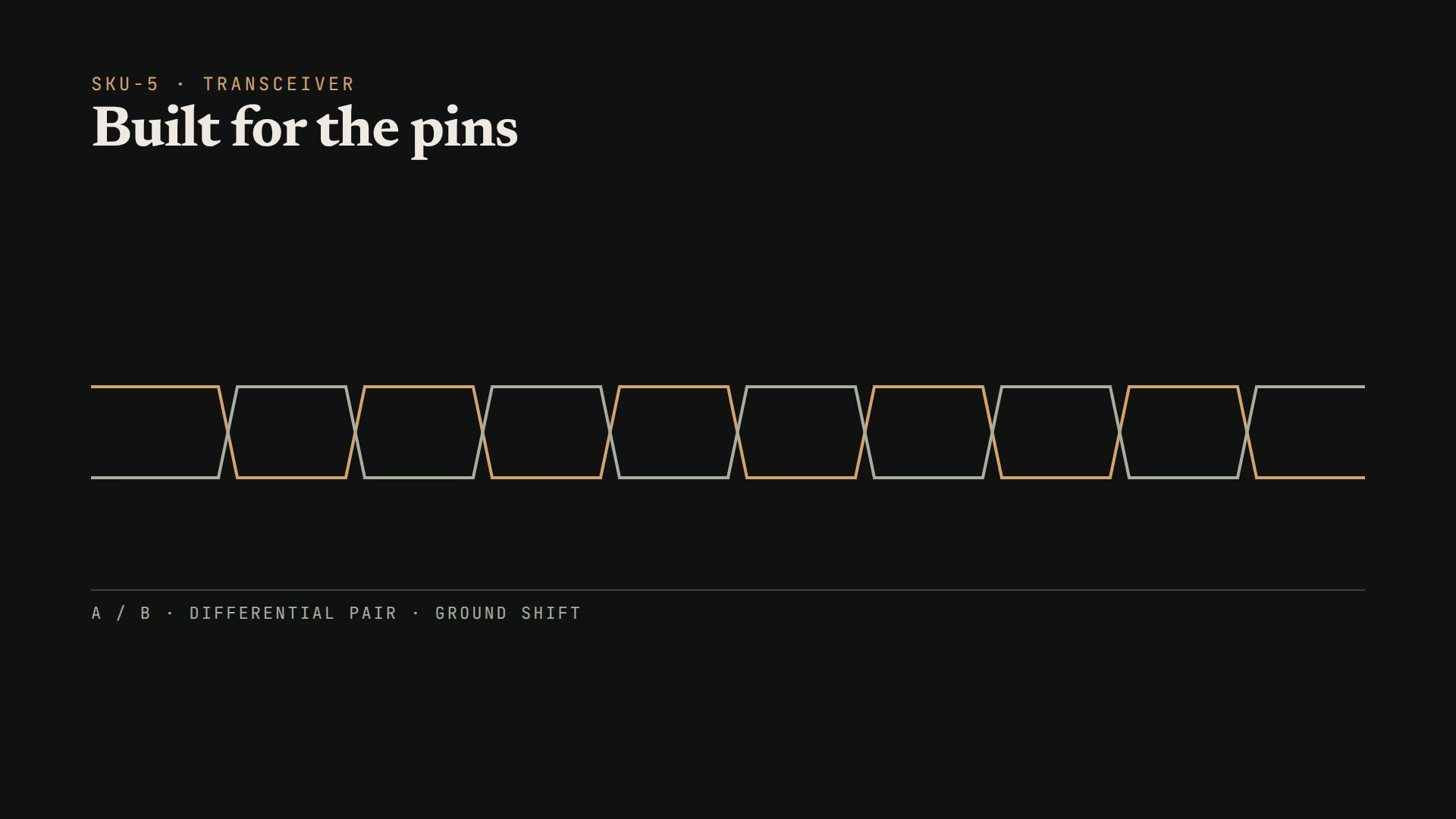
SKU-5Robust Transceiver130 nm HV
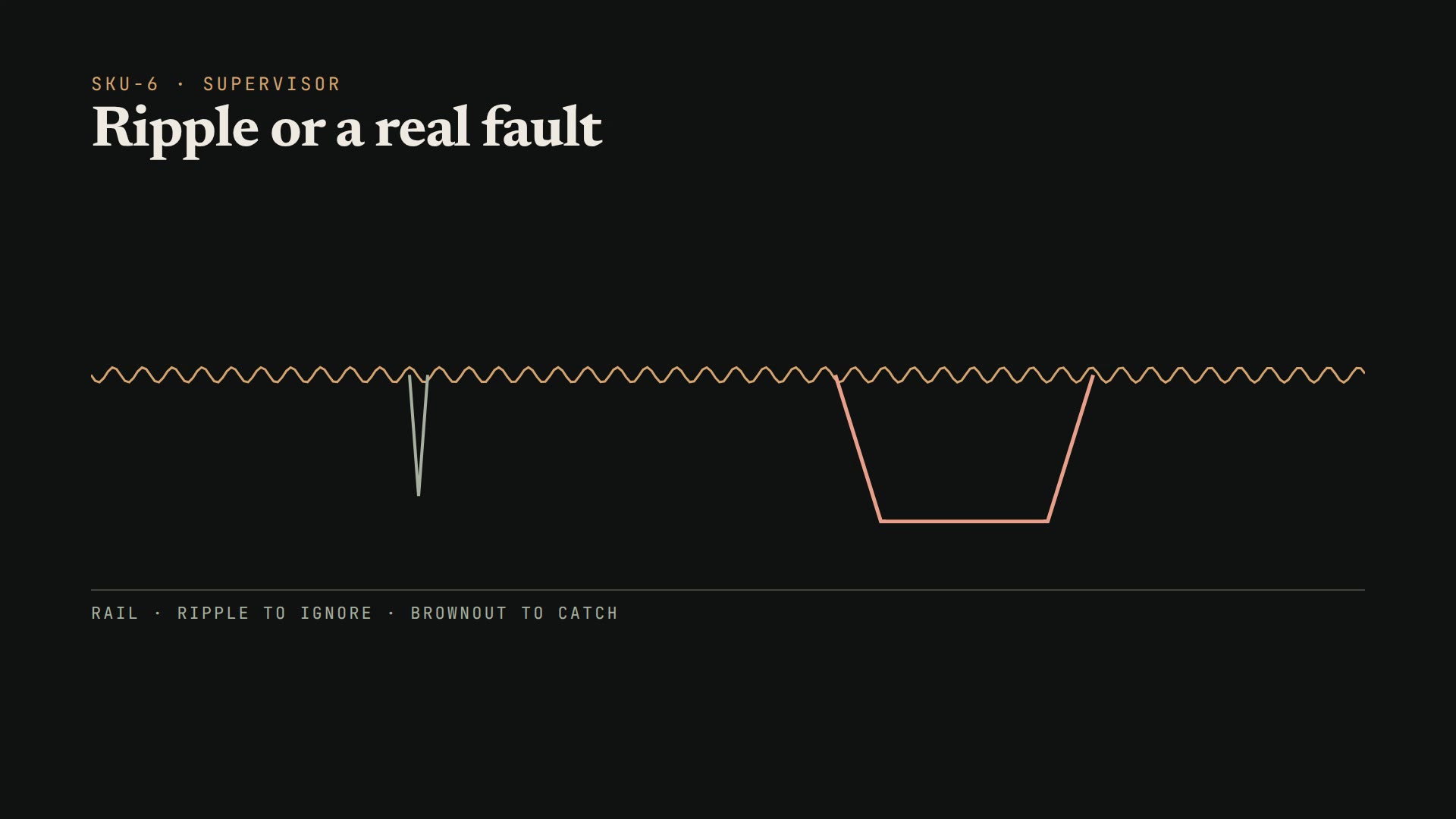
SKU-6Voltage Supervisor180 nm CMOS
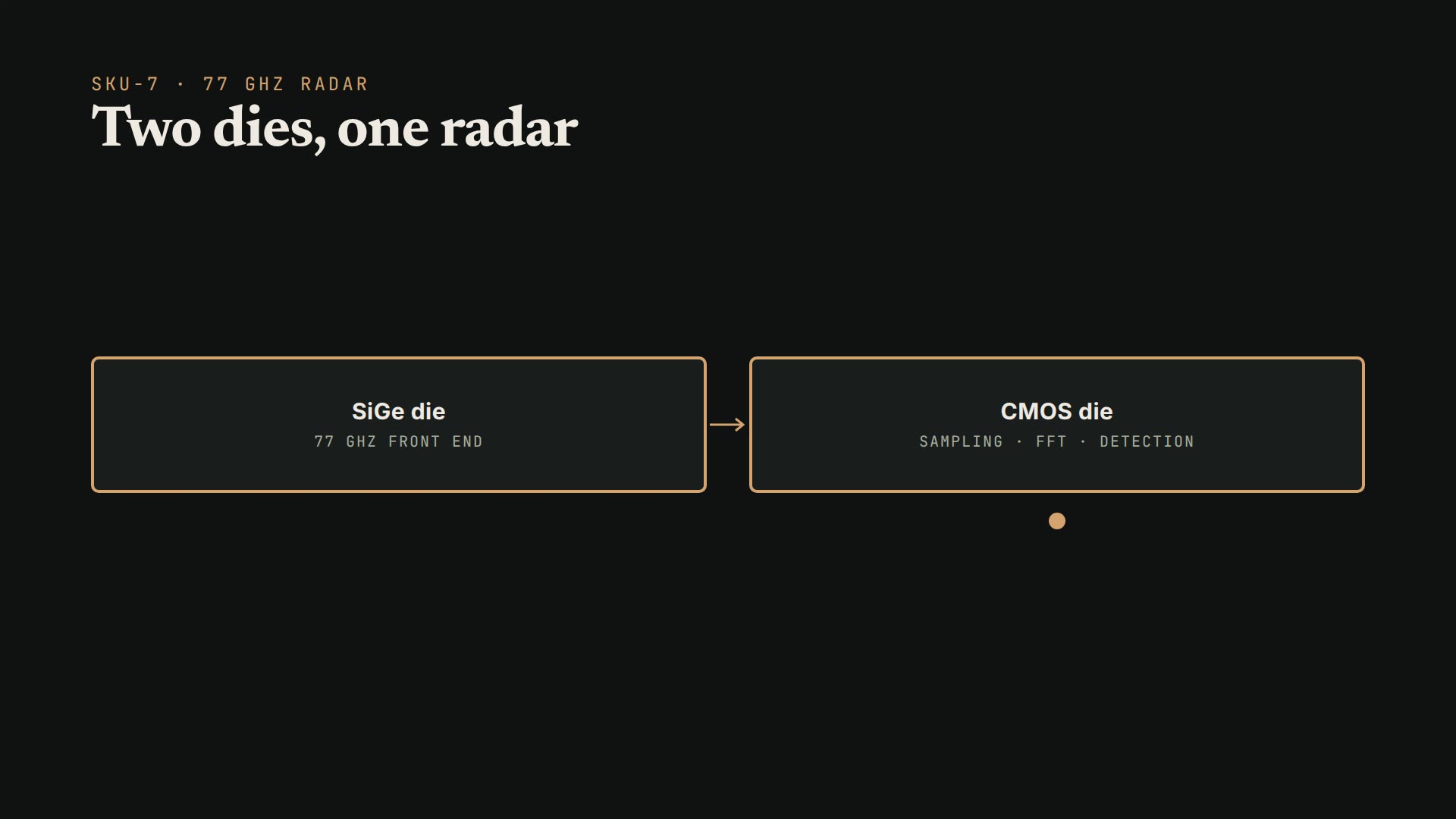
SKU-7DG-RADAR-770.13 µm SiGe BiCMOS
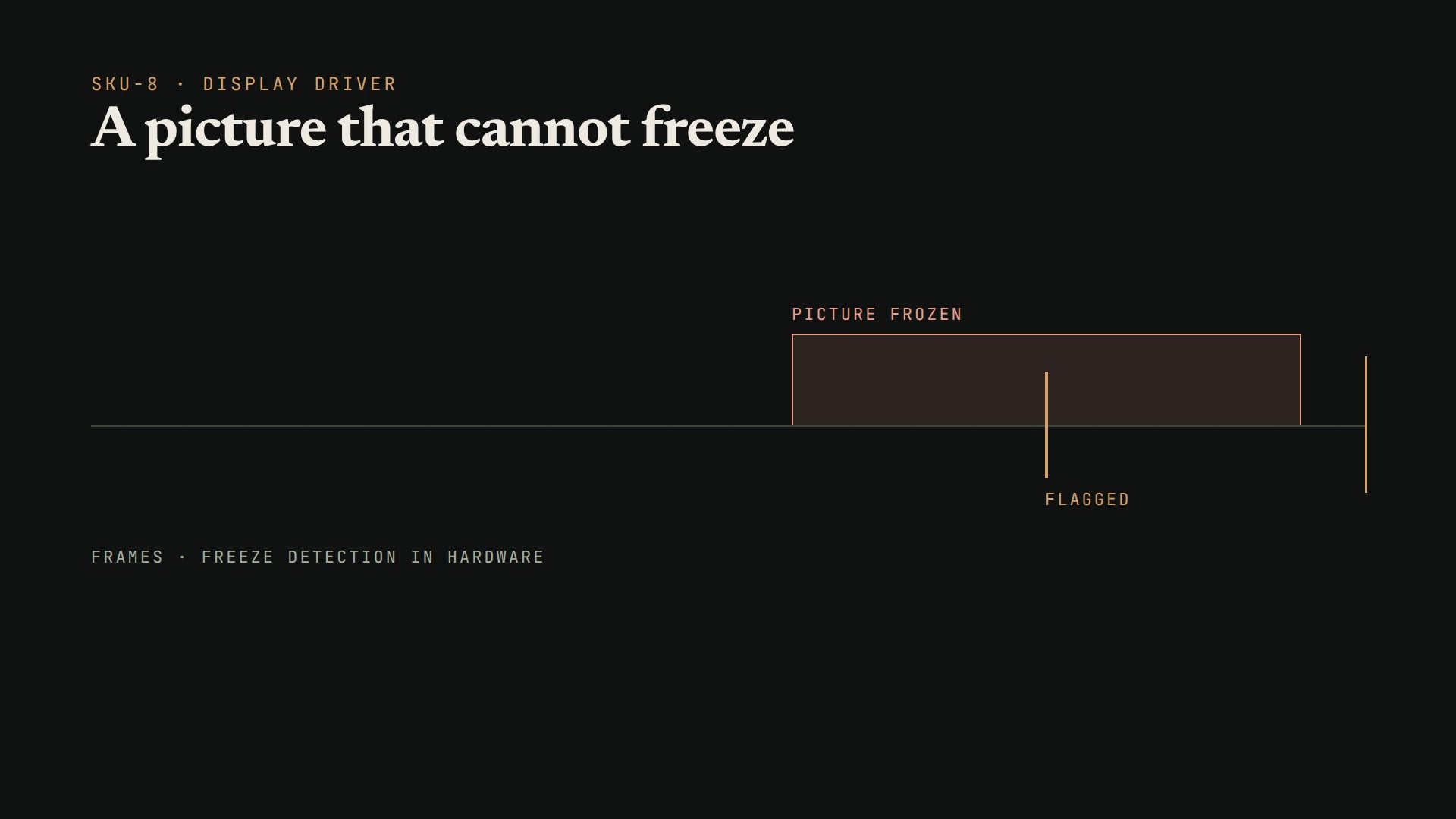
SKU-8DG-DISP-17130 nm HV CMOS
SKU-9DG-SDV-ZONE130 nm CMOS and BCD
SKU-10DG32-Max130 nm CMOS (SKY130)
SKU-11DG-BMS-SOH130 nm CMOS (SKY130)
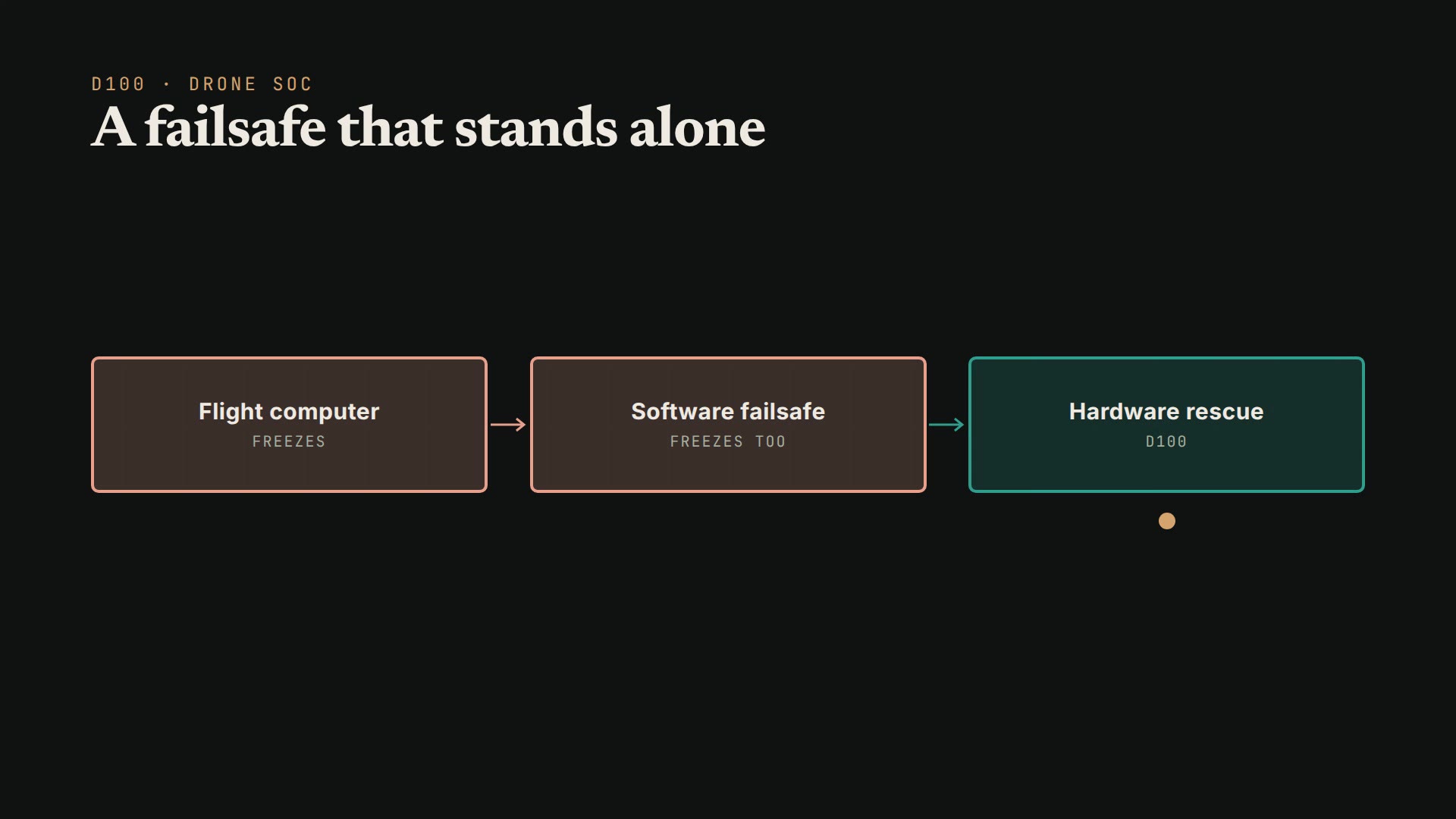
Track BDG-D10028 nm; failsafe island buildable at 130 nm

Portfolio, numbering and nodes follow the SKU Blueprint, October 2026. Phase names the sovereignty foundry, not a date: Phase 1 SkyWater, Phase 2 IHP, Phase 3 SCL Mohali. Anchor customers and contract values are held off this table pending verification.

Start on DG32-LITE;
move to DG32-2DOM when the drive should watch its own motor.

Choose DG32-LITE

For a drive that needs hardware lockstep safety, hardware FOC acceleration and native DShot in a 64-pin part.

WHYIt is pre-silicon. Bring-up must measure loop costs, fault latency, timing and electrical behaviour before design values become silicon results.

Choose DG32-2DOM

For a drive that should also watch its own motor: bearing-fault or anomaly detection on phase-current data, without a second processor.

WHYThe engine runs on its own clock behind bridges, so condition monitoring cannot extend the control core’s worst-case execution time. Design complete, in physical trials.